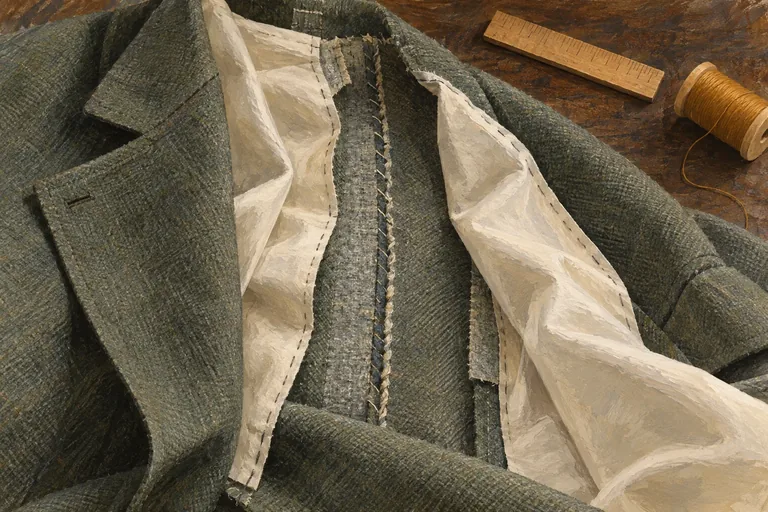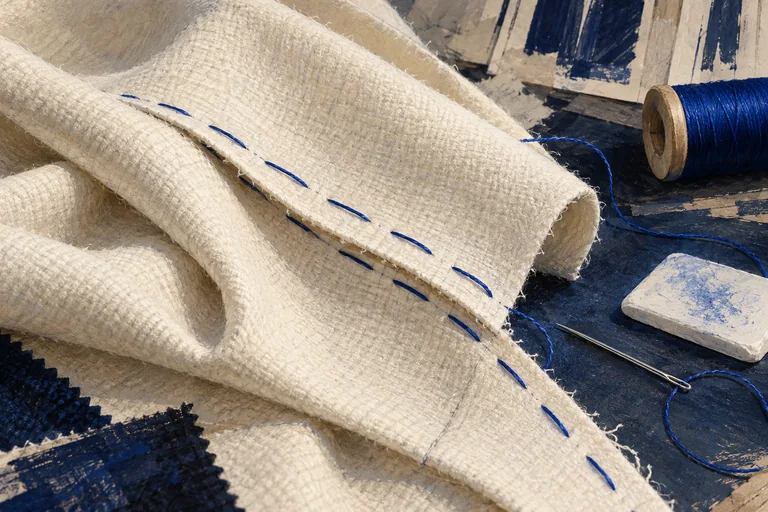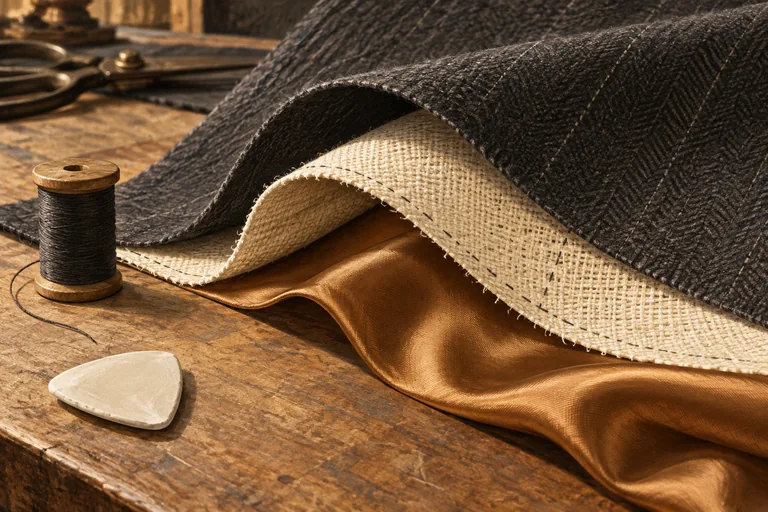
Milan textile looking: how does a knitted loop differ from a woven crossing?

A textile’s colour may catch your eye first; its structure explains a different part of its character. During a Milan fashion visit, learning to distinguish knitted loops from woven crossings gives you a precise question to ask about a garment. It also helps you resist an easy mistake: treating every soft fabric as knitted, or every crisp one as woven.
Begin with a sample you are allowed to examine, or a clearly visible detail in an exhibition. The aim is to understand the organisation of yarn, not to establish quality from a glance. A knitted textile and a woven textile can each be carefully made, suited to their purpose and visually complex.
Look for the relationship between yarns
The TextielMuseum explains knitting as the formation of connected loops from yarn, using hand needles or machines. Its account distinguishes flat and circular machine knitting and describes possibilities ranging from panels to seamless forms. Weaving, by comparison, interlaces yarn systems. At a useful viewing scale, the question is whether you can follow a loop or a crossing, rather than whether the surface resembles a familiar jumper.
Some structures are difficult to identify without magnification or specialist knowledge. A patterned surface can conceal the underlying construction, and a knitted structure can be designed to have a woven appearance. The TextielMuseum describes inlaid yarns among the possibilities of machine knitting. If the visible evidence does not settle the matter, ask the maker or retailer instead of promoting an impression into a fact.
In a shop, request a suitable sample before stretching or turning anything inside out. In a museum, use the displayed view, label or approved digital enlargement. A case is not an obstacle to be overcome: it establishes the conditions under which a vulnerable object can be shared with visitors.
Separate structure from fibre and finish
A fibre name does not answer the structural question. Our guide to fibre, yarn and fabric separates those levels of description. Ask what the textile is made from, how the yarn is organised and what later treatment contributes to its surface. These are related questions, but none replaces the others.
Likewise, do not make stretch a universal identification test. Structure, yarn, density and finishing can all affect how a textile behaves. You may observe that a permitted sample extends in one direction more readily than another, but that observation alone does not establish every aspect of its manufacture. Our weave and finish guide offers a useful next step for keeping those distinctions clear.
Try describing two samples without evaluative adjectives. One might show repeated small loops; another might reveal two directions of yarn. One may allow more light through at the same viewing distance. This kind of description is more informative than calling one luxurious and the other ordinary before you know their intended use.
Do not make handwork and machine work into opposing values
The V&A’s knitting collection includes both hand- and machine-made work across different kinds of dress. Its historical account also discusses a seventeenth-century Italian silk knitted jacket assembled from flat pieces. Such surviving objects challenge the assumption that knitting belongs only to casual modern clothing, while reminding us that a garment’s construction needs object-specific evidence.
That Italian example does not establish a Milan origin, and an old knitted garment should not be described as handmade merely because it is old. Read the catalogue’s attribution and technical description. Where a method remains uncertain, uncertainty is part of the account. Fashion history becomes more interesting when it retains the evidence that supports a claim.
For a contemporary purchase, ask how the structure serves the design. Does a maker discuss shaping, panels or seams? What care is recommended? What repair advice is available? These questions reveal more about living with a garment than an unsupported promise that one production method is always superior.
Connect the textile with the finished silhouette
Once you have identified what you can about the structure, look at what the designer asks it to do. Where does the garment hold shape, hang or fold? Our guide to pleats and movement considers another way material and construction work together. Compare the textile with the garment without assuming that a small sample predicts every effect of the finished piece.
A separate visit to Como’s Silk Museum can develop questions about textile processes through museum interpretation. Como is its own destination; a Milan shopping appointment does not include a lake-side museum visit unless that journey is expressly arranged.
For Fashion Week planning, CNMI’s current next editions are menswear on 15–19 January 2027 and womenswear on 23 February–1 March 2027. Official shows operate by invitation. Our fashion and culture collection may help you compare shopping or design experiences, but those services do not confer runway invitations, accreditation or backstage access. A well-chosen textile question can enrich an ordinary public visit on any date, without requiring a place beside the runway.
Sources & further reading
Turn a good read into a great day.
Find a highly rated Milanese experience that brings these stories to life.
Explore related experiences →