Milan fashion looking: how does interlining differ from a lining?

A jacket can look wonderfully simple while containing several fabrics that do very different jobs. The cloth you see from outside, the smooth layer you see inside and the support hidden between them should not be treated as interchangeable. For a fashion-minded Milan visit, understanding those roles makes a fitting-room conversation more useful and a museum label more interesting.
The first rule is to ask what a layer does before becoming attached to its name. Textile terminology varies between teaching traditions, manufacturers and countries. “Interlining” may describe internal support in one context and a warmth-giving layer in another. A precise question about structure or insulation will get you further than confidently correcting a maker with a single dictionary definition.
Begin with the lining you can see
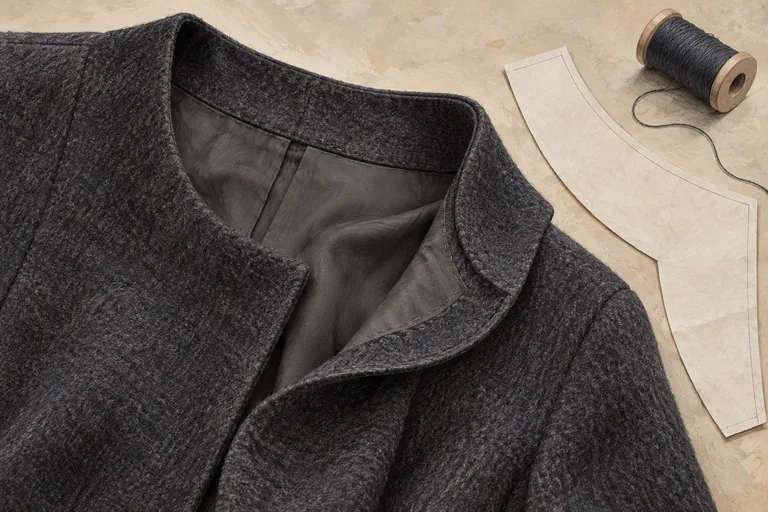
New Mexico State University’s construction standards describe a lining as concealing the garment’s inner construction without unnecessary bulk, fitting smoothly and having care requirements compatible with the outer fabric. This gives you a practical way to look: does the lining allow the garment to sit comfortably, or does it pull, bunch or restrict movement?
That does not make a particular fibre automatically superior. A lining should suit the garment’s purpose, the wearer and its care requirements. Try the ordinary movements for which you intend to use the piece, with the shop’s permission: sit, reach gently and put on any outer layer you expect to wear with it. Our article on what a lining can reveal develops that visible part of the story.
What might be hidden underneath?
The manufacturer Vlieseline uses “interlining” for products supporting parts such as collars, cuffs and jacket fronts. Its range includes different constructions and weights intended for different outer fabrics. In that vocabulary, the hidden layer contributes to the way a particular area holds its form.
By contrast, the CBSE Fashion Studies textbook separates lining and insulating interlining from underlining and interfacing, which it discusses in relation to shape and support. These are not contradictory observations about one identified garment. They are different naming systems. When speaking with a tailor, ask whether the layer supplies warmth, stabilises an edge or helps build the intended silhouette.
Imagine two garments that both feel substantial: one might owe that impression mainly to the outer cloth, while another combines lighter cloth with internal support. A photograph cannot settle the question. Nor can the visible lining tell you how every hidden area was assembled. The distinction between fibre, yarn and fabric provides another useful reminder that material names describe different levels of construction.
A better conversation in a Milan shop
Start with your actual use. Will this be a jacket for long train journeys, an occasion piece, or a winter layer worn over knitwear? Then ask which parts have internal support, whether that support is sewn or bonded, and what the maker recommends for care and alterations. You are gathering information, not demanding that staff dismantle a garment.
A sewn construction is not an automatic verdict on the entire piece, and a bonded layer is not automatically a fault. Suitability depends on the materials, application and intended result. Avoid turning one feature into a universal luxury ranking. Our guide to looking at garment construction while shopping keeps the discussion grounded in fit, finish and intended wear.
How does this change a museum visit?
A mounted garment may conceal the very layers you want to understand. Look for a conservation photograph, technical drawing or label that explicitly identifies its construction. If none is supplied, record the question rather than inventing an answer from the silhouette. Never handle or lift a historic garment to investigate. An attractive line at the shoulder might involve cutting, padding, support, mounting or several of these together.
The same care with evidence applies to manufacturing displays. Como’s Silk Museum offers a separate destination for thinking about how cloth is produced; it does not by itself explain how an individual Milan garment was constructed. Keeping those stages distinct makes the comparison more rewarding.
Give curiosity a sensible itinerary
Choose one fabric or construction question for a shopping afternoon, then leave time to enjoy the city. The Milan fashion and culture experience collection includes activities whose specific stops and services should be checked before booking. Shopping, tailoring advice and museum visits do not supply official runway invitations or backstage access. A useful result can be much quieter: understanding why a garment feels the way it does, and knowing which parts of that explanation remain unseen.
Sources & further reading
Turn a good read into a great day.
Find a highly rated Milanese experience that brings these stories to life.
Explore related experiences →