Milan fashion looking: how does a garment facing finish an opening?

The edge of a neckline can look almost effortless. Cloth turns neatly away from the opening, the seam stays discreet, and the garment appears to know where to stop. A facing may be doing some of that quiet work. Learning the term gives a Milan fashion visit one more useful question: how has this opening been finished, and what does that choice contribute to the way the garment sits?
What is a facing, in plain language?
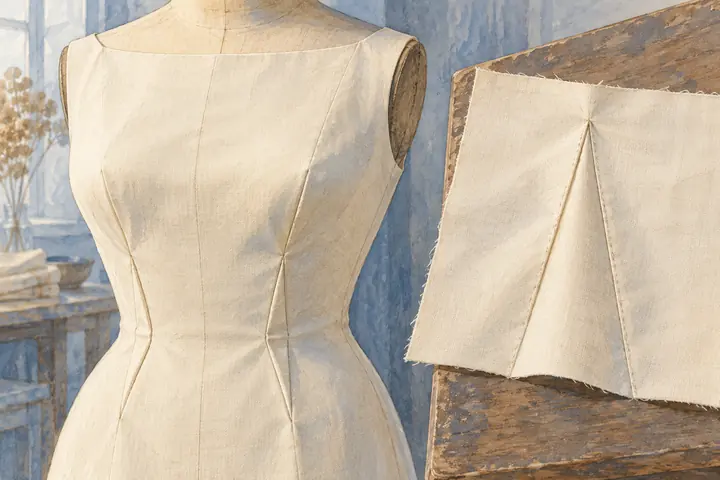
New Mexico State University’s extension guide explains facings as a way to finish raw edges at openings such as necklines and armholes. A facing can be a separate shaped piece, or an extension that folds back. Its relationship to the main fabric matters because the two need to behave together around the opening. This is construction guidance, not evidence that one designer or country invented the technique.
For a visitor, the most useful first distinction is between an edge treatment and a complete interior layer. A facing usually addresses a particular opening or boundary. A lining covers a broader interior area. Interfacing is another role again, supplying support within construction. These elements can work together, and a visible strip of fabric does not let you confidently identify everything hidden behind it. Our guide to garment linings gives that companion subject its own attention.
Imagine following the path of an opening with your eyes. Where does the outer fabric turn? Is a seam visible, or has it been placed away from the exterior edge? Does the finish continue around a corner? You are building a vocabulary of observations. You do not need to decide instantly whether the garment is exceptionally made, inexpensive, old or new. A construction feature is evidence for a construction choice; broader judgements require more information.
What should you notice around a curve?
An archived South Dakota State University factsheet on collars, facings and pockets treats the behaviour of edges, curves and corners as practical making problems. Think about the difference between turning a straight strip and turning cloth around a curved opening. The resulting edge asks different parts of the material to occupy different positions. The neat exterior is the visible outcome of decisions that may be largely concealed.
Look at the garment in the position in which it is meant to be worn. Does the opening lie calmly, or does an inner edge roll into view? Is that appearance consistent with the design, or is it something to ask about? A dramatic contrast facing may be intended to show. A quiet finish may have been designed to disappear. Resist turning every exposed edge into a fault before understanding the garment and its intended arrangement.
The Sydney Community College course on facings places the technique alongside pattern work, fabric grain and interfacing. That is a useful reminder that the finished edge is part of a system of choices. It is not a magic quality marker that can be judged in isolation. If you want to learn to make one, use a suitable class or complete technical guide; looking at a museum object is not a substitute for instructions tailored to your fabric and pattern.
How can you look without handling a historic garment?
In a museum, use the visible opening, the label and any permitted detail image. Do not reach into a display or assume that a pale patch seen through glass is a particular material. If the inside is hidden, write down the question for a catalogue search. The absence of a view is not evidence that a facing is absent. A careful “I cannot tell from here” often produces a better next step than a confident guess.
Our guide to buttons and closures helps you connect an opening with the way it is secured. Toiles and the design process offer another distinction between a working stage and a finished piece. For a wider Milan context, looking at everyday design encourages the same patient attention to edges, joints and use.
What is worth asking in a shop?
With permission, ask a staff member to show how the neckline or front opening is finished. Try the garment on as intended, move normally and consider whether the opening remains comfortable. Ask about alteration limits before assuming that a neckline can be changed without affecting the facing, lining or closure. Let a qualified professional assess the actual piece. An attractive interior is not a promise that every alteration will be simple.
If you add a guided activity, read our fashion experience collection for the specific shopping or cultural itinerary. These activities do not imply official runway entry. For dates, the CNMI calendar currently places the next men’s Milan Fashion Week on 15–19 January 2027 and the next women’s edition on 23 February–1 March 2027. A construction-focused visit can be rewarding outside those dates too: one carefully considered edge is quite enough to begin a conversation.
Sources & further reading
Turn a good read into a great day.
Find a highly rated Milanese experience that brings these stories to life.
Explore related experiences →