Milan fashion looking: how do darts turn flat cloth into volume?

A dart can be almost invisible in a finished garment, yet it helps answer a fascinating design question: how does flat cloth accommodate volume? While looking at clothes in Milan, pause over a line that narrows towards a point. It may reveal a decision about shape more clearly than a decorative detail does. Learning to recognise that decision makes shop windows, museum displays and fittings more interesting without turning them into an examination.
What does a dart do?
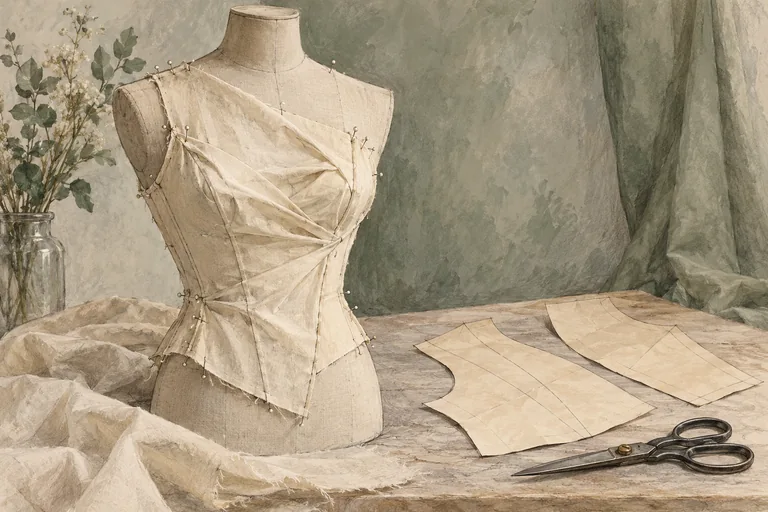
The V&A’s garment-making teaching material describes darts as shaped, stitched folds. Taking up part of the cloth allows the surrounding material to form volume. In a simple example, a fold narrows towards a point; in a garment, its position and shape respond to the design. This is a useful starting definition, not a rule that every dart must look identical or sit in the same place.
Look first at where the line begins and ends. Does it run from an edge towards a fuller area? Does it taper within a panel? Then stand back and notice the overall silhouette. The small construction choice and the larger shape belong to the same discussion. Avoid handling a display garment without permission, and remember that lighting, lining or a mannequin may conceal the detail you are trying to understand.
How is it different from a pleat or a seam?
A fold is not automatically a dart. A pleat may retain folded fabric that opens or moves as the garment is worn. A seam joins pieces and may itself help shape the garment. These features can coexist, and a designer may distribute shaping through several of them. If a detail remains ambiguous from the outside, that is a reason to ask a knowledgeable member of staff, not to force it into a category.
Our guide to pleats, structure and movement offers a useful companion. Compare how a folded area behaves when the wearer moves, where observation is appropriate, rather than judging from a single frozen photograph. The bias cut raises a different question about the orientation and behaviour of cloth. A dart, a pleat and a bias-cut panel are not competing badges of quality; each can serve a particular intention.
What does a historical account add?
In the V&A’s extract from Barbara Hulanicki’s recollections, the designer describes a particular short pink gingham dress made for Biba in 1964, including its two darts. The specificity is valuable: a named maker recalls an identified design in a London business context. Read it as a first-person account. It does not establish that every Biba dress used the same construction, nor does it relocate that history to Milan.
Such evidence suggests a good museum habit. When you see a garment, distinguish the object in front of you from a later photograph, a pattern, an oral recollection or a curator’s interpretation. Each can answer different questions. A surviving garment may show stitching that a photograph cannot, while a maker’s recollection may explain an intention the fabric alone cannot prove. Good fashion history allows these forms of evidence to converse without pretending they are interchangeable.
A separate V&A upcycling worksheet uses a dart in a specific altered garment. That example helps demonstrate the principle, but it is not a universal alteration prescription. Do not cut into a valued piece because a small diagram appears straightforward. The amount of cloth available, its condition and the rest of the construction affect what can sensibly be changed. A professional assessment is especially useful when the garment has a lining or limited seam allowance.
What should you notice during a fitting?
Look at the garment in a comfortable standing position, then move as you expect to move while wearing it. Sit, reach gently and check the view from more than one angle, following the shop’s guidance. Ask whether a visible pull or an unwanted shape can be adjusted and what the work would involve. The aim is a garment that suits its wearer and purpose, not a wearer who must conform to an abstract ideal.
A toile or trial garment can help a maker explore these relationships before the final material is committed. Visible darts alone, however, prove neither bespoke manufacture nor hand sewing. Equally, their absence does not prove that no shaping work has taken place. Clothing rewards attention to the whole construction rather than one prestigious-sounding feature.
For another perspective on form and production, consider Milan’s Triennale design museum as a separate cultural visit. Our Milan fashion and culture experiences can help you compare guided activities, with their actual access and inclusions checked individually. Shopping and craft visits do not confer Fashion Week invitations or runway entry. A well-chosen afternoon can instead leave you with a more durable souvenir: the ability to recognise how a quiet line of stitching changes a piece of cloth.
Sources & further reading
Turn a good read into a great day.
Find a highly rated Milanese experience that brings these stories to life.
Explore related experiences →