Milan’s Trivulzio tapestries: seasons, work and represented dress

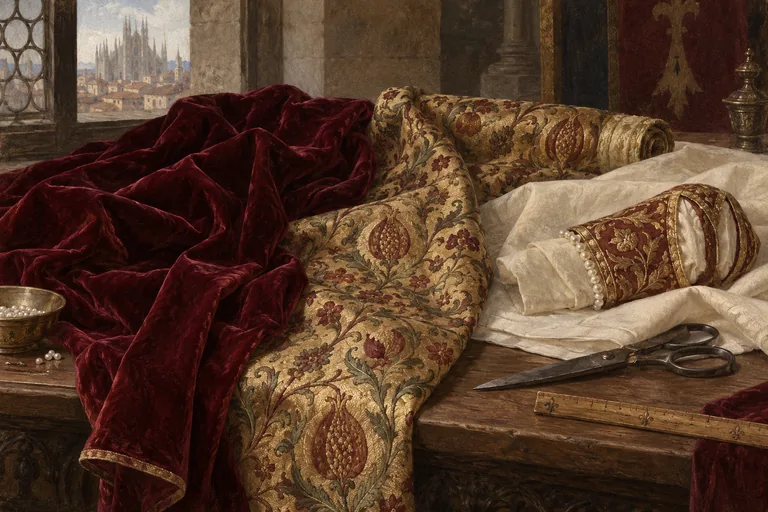
The Trivulzio tapestries at Milan’s Castello Sforzesco invite fashion-minded visitors to look beyond garments. A woven image can represent clothing, work and social identity while being a remarkable textile in its own right. That double perspective is the pleasure of the visit: you can study what the figures wear and how threads make the whole scene visible.
Begin with one tapestry rather than attempting to absorb the entire cycle immediately. Let the large arrangement settle into view, then move toward smaller details from the permitted viewing distance. Our guide to clothing in Renaissance portraits offers a useful principle: represented dress is selected and composed, not a neutral record of everyone’s wardrobe.
Place the cycle in its Milanese context
The Castello’s collection highlights identify the cycle of twelve months with designs by Bartolomeo Suardi, known as Bramantino, and weaving at Vigevano by Benedetto da Milano and collaborators. Gian Giacomo Trivulzio commissioned it. Design, patronage and skilled textile production therefore all belong to the story.
The museum’s family guide dates the works to 1504–1509. Think of that as the setting for an early-sixteenth-century project, not permission to assign every depicted hat or sleeve to an exact year. A work of art can combine observation, convention and symbolic design.
Read the seasonal structure
The museum explains that each hanging represents a month, with seasonal agricultural activities and a central figure. Its guide draws attention to the sun, zodiac signs and the patron’s heraldic presence. These provide a framework for looking: the scenes are organised images, not simply crowded views of rural life.
Choose a detail that suggests a season, then ask how you reached that conclusion. Was it an activity, a plant, a tool or something in the composition? Compare your answer with the museum’s explanation. This small exercise turns passive viewing into a conversation with the work while leaving room to correct a first impression.
Look at represented dress carefully
Notice how clothing helps figures occupy different roles in the scene. Does a long outline make someone appear formal or still? Does a shorter garment make movement easier to read? These are questions about visual presentation. They should not become confident claims about the clothes of an entire social group without supporting historical evidence.
Our introduction to dress and power in courtly Milan supplies a broader context, while preserving differences between periods and patrons. Look for the relationship between the figure, the setting and the purpose of the image. A textile commissioned for display is not the same kind of source as a surviving work garment.
Remember that the picture is woven
Step back and the scene can read like a continuous image; closer looking reveals the question of how colour and contour become thread. You need not identify every fibre by eye to appreciate the technical translation involved. Our fibre, yarn and fabric guide helps distinguish the levels of making without guessing the composition of an individual object.
The Ministry of Culture’s collection record also traces the cycle’s later movements and acquisition by the Municipality of Milan in 1935. The museum setting is therefore one chapter in a longer history of ownership and display. What survives today has travelled through changing contexts.
Arrange the museum visit around the actual route
Check the Castello’s current museum information, opening arrangements and any room closures before making the tapestries the sole purpose of a visit. The collection is associated with the Sala della Balla; use the museum’s current guidance to locate it. A general castle walk does not necessarily include museum admission or access to every collection.
Our sister site’s Sforza Castle introduction helps distinguish the wider complex from its different visitor experiences. Leave time for the tapestries themselves instead of treating them as a brief stop between unrelated highlights.
Explore our Milan design and culture collection for additional options and confirm each product’s named stops. The Trivulzio cycle can enrich a fashion visit without needing to resemble a modern show. It offers something more particular: a chance to see material skill, seasonal imagery and represented dress working together at architectural scale.
Sources & further reading
Turn a good read into a great day.
Find a highly rated Milanese experience that brings these stories to life.
Explore related experiences →