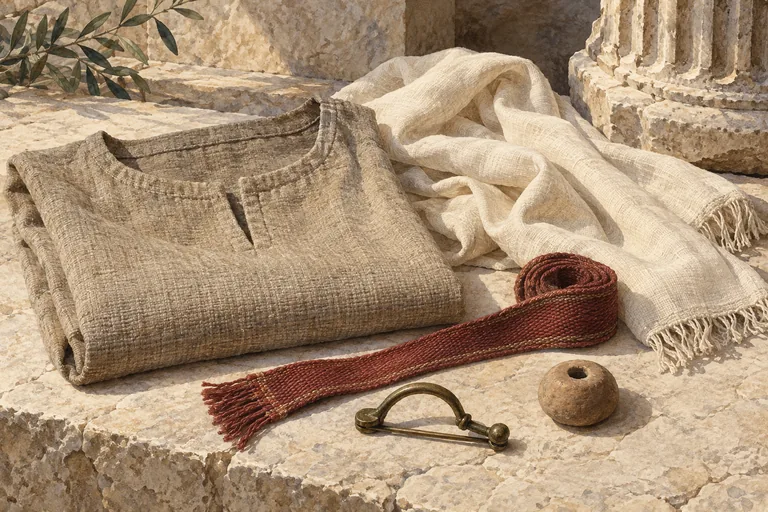
What can a Roman brooch tell us about clothing?
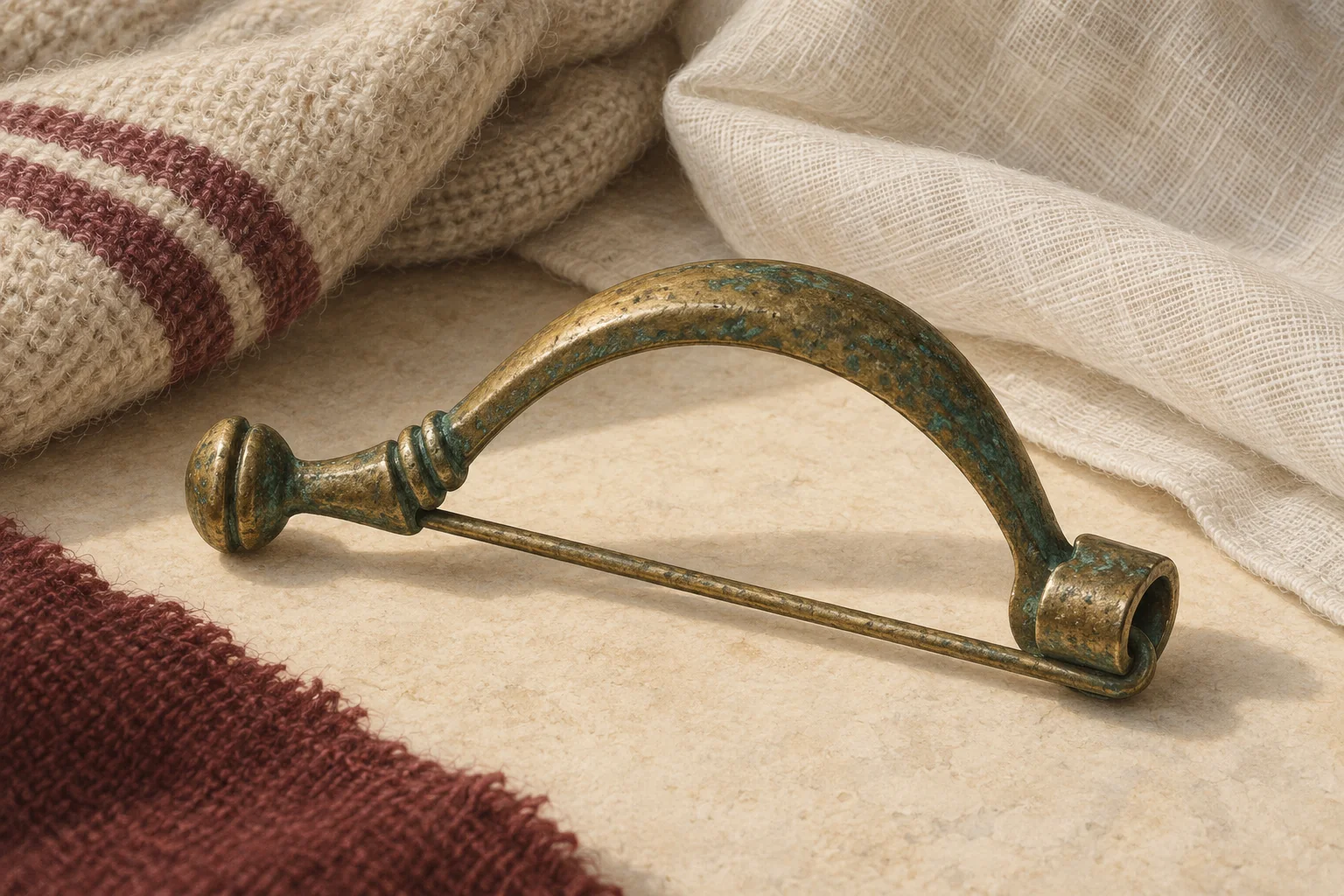
A Roman brooch can make ancient clothing feel unexpectedly practical. Before asking whether an object is beautiful, ask how its pin held fabric together. A small fastening device connects the dressed body with metalworking, daily movement and public appearance. It can preserve evidence long after the cloth around it has disappeared, but it cannot tell an entire wardrobe’s story on its own.
For a Milan fashion itinerary, this is a useful change of scale. Our introduction to dress in Roman Milan considers the wider evidence. Here, the pleasure lies in looking closely at one kind of object without turning every surviving brooch into proof of a universal Roman style.
Begin with the mechanism
The Metropolitan Museum’s study of a late antique crossbow fibula describes its bar, bow, pin and catch. It also explains the connection between this particular family of brooches and military or administrative rank. That is evidence about a type and its historical setting, not permission to assign the same status to every ancient pin. The museum’s published research gives the object a context beyond its silhouette.
When you encounter a brooch in a display, follow the fastening with your eyes. Where would the point travel? What would stop it slipping free? Which surface faced outward? If the case only reveals the front, note that limitation. A photograph of the reverse or a museum diagram may answer a mechanical question that the most flattering view cannot.
Material and decoration are separate clues
Not every brooch has the same visual ambition. A British Museum record describes a Roman copper-alloy brooch shaped like a spotted leopardess, with enamel and glass decoration, dated to the second or third century. Its pin is missing, and the record identifies it as not on display. This documented animal-shaped example shows why a functional category can contain very different decorative choices.
Compare that with the Met’s fourth-century bronze crossbow brooch, whose catalog describes a four-sided bow and incised lines. These are comparative objects in London and New York collections, not items we are promising you will see in Milan. Their value here is methodological: material, form, date and recorded condition deserve individual attention.
Read the label before imagining the wearer
A good object note separates manufacture, discovery and later ownership. An object found in one place was not necessarily made there. A date range is not a precise year. A collector’s name is not the name of an ancient wearer. Small differences in those labels can change an attractive story into an unsupported one.
Use a simple notebook exercise. Record what you can observe, what the museum identifies, and what remains a question. A visible broken pin belongs in the first column; a scholarly attribution belongs in the second; a proposed color of lost fabric belongs in the third unless supported by evidence. The distinction makes your observations more interesting, not less imaginative.
Bring the question back to Milan
Milan’s Civic Archaeological Museum presents ancient Mediolanum through artistic production, everyday objects, inscriptions and surviving archaeological structures. Its Roman section provides a local framework for thinking about the people who inhabited the city. Check the current display and access information before planning around a specific object; a collection description does not guarantee that every holding is in a case.
Pair the visit with one nearby cultural stop rather than a race through unrelated institutions. Browse our design and culture experiences for clearly described visits, or use Milan Tour Hub to place the archaeological museum within a broader city day. Confirm whether admission, guiding and transport are actually included in the option you choose.
A useful way to look at later fashion
The same questions travel well across centuries. When looking at a painted sleeve, distinguish represented fabric from surviving cloth; our guide to reading Renaissance portraits through clothing develops that comparison. When shopping, consider the relationship between a closure and the garment’s movement, as in our guide to examining garment construction.
Consider scale as well as surface. A close photograph can make a tiny fitting look monumental, while a display case can make a substantial clasp seem delicate. Read the recorded dimensions before imagining how it sat against fabric. If taking permitted photographs, include a note of the object number so later research leads back to the right record.
You do not need to claim an unbroken design lineage between a Roman fibula and a modern clasp. The richer connection is a habit of attention: beautiful clothing also has to stay on a moving person. A brooch reminds us that fastening, comfort, display and meaning can meet in a remarkably small piece of work.
Sources & further reading
Turn a good read into a great day.
Find a highly rated Milanese experience that brings these stories to life.
Explore related experiences →