Milan fashion museums: does a permanent collection stay on permanent display?

A garment appears in a museum’s online collection, a guidebook praises it, and a photograph makes it look like the perfect focus for a Milan afternoon. There is still one question to answer: is it on display during your visit? A permanent collection is a body of objects held by an institution. It is not a promise that every object remains permanently visible in the same room.
Separate ownership, display and exhibition dates
Begin with three different pieces of information. A collection record describes an object and its institutional history. An “on view” statement concerns its current presentation. An exhibition page gives the dates and scope of a particular event. These can overlap, but one should not silently stand in for another.
When planning around a single garment, record its title or collection number and look for a current display statement. If the page is unclear, ask the museum whether that specific item is expected to be visible on your date. A focused enquiry is easier to answer than a general request for everything related to fashion. Our Palazzo Morando introduction can orient a Milan visit, while the museum’s own current notices must settle what is actually accessible.
A permanent gallery can still rotate its contents
The V&A Dundee’s account of a gallery rotation describes objects returning to lenders and new pieces taking their place. Its curatorial and conservation staff explain that loan agreements, sensitivity to light and the opportunity to tell new stories all contribute. This is evidence of one institution’s practice, not a claim that every Milan museum follows the same timetable.
The distinction is useful nonetheless. “Permanent gallery” can describe an enduring subject or space while the objects change. A favourite photograph may document an earlier arrangement. Before treating it as an itinerary, check when it was taken and whether the current exhibition information still supports the expectation.
Conservation adds time to the display decision
Our article on light and historic dress explains the basic tension between visibility and textile preservation. Here the planning consequence matters most: a museum may decide that a sensitive object should spend only a limited period on display. Its absence does not by itself indicate damage, neglect or a cancelled exhibition.
The George Washington University Museum and The Textile Museum’s care guidance recommends limiting display periods to manage exposure. Such guidance establishes the importance of duration; it does not give visitors a universal calendar for every dress, fibre or institution. Ask about the actual display rather than calculating an object’s supposed entitlement to be on view.
Some rotations change only part of what is visible
The V&A’s account of the Bullerswood Carpet describes a particularly striking solution: the large textile is displayed with only half visible and periodically rotated. The example concerns a carpet in London, not a Milan garment. It shows why the word “displayed” can still leave important questions about what portion or aspect you will see.
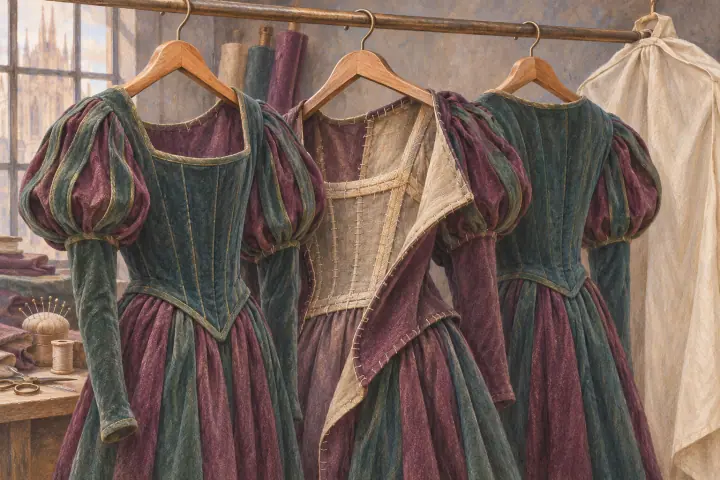
A fashion display can also shape your understanding through its angle and support. Our guide to mounting historic garments helps distinguish the object from the presentation chosen for it. A rear view missing from the case may be available in a catalogue photograph, but that photograph remains a different form of access.
Build a visit around a worthwhile question
If one object is unavailable, decide whether the broader collection still answers your interest. You might follow how fabric becomes volume, how a label separates maker from donor, or how accessories relate to the body. This is more satisfying than replacing an absent “must-see” with a hurried circuit of everything else.
Give yourself permission to change the plan. A confirmed temporary exhibition may suit your purpose better than a large permanent gallery, or vice versa. Our museum-day planning guide suggests leaving time to think between visits. Fewer appointments also make it easier to adapt when a room closes or a particular object is rotated.
Check what a booking actually includes
Browse Milan design and culture experiences for visits whose stated subjects match yours. Museum admission, a temporary exhibition supplement, a guided route and private archive access are different arrangements. Confirm any inclusion that is essential to the day, especially if a description uses the broad word “collection”.
For a wider regional comparison, Como’s Silk Museum guide approaches textiles through manufacture. Check its own current access separately. A well-planned fashion visit is not the one that guarantees an old photograph will come to life. It is the one that makes room for the actual objects, evidence and opportunities available when you arrive.
Sources & further reading
Turn a good read into a great day.
Find a highly rated Milanese experience that brings these stories to life.
Explore related experiences →