Milan fashion looking: what can embroidery reveal beyond decoration?

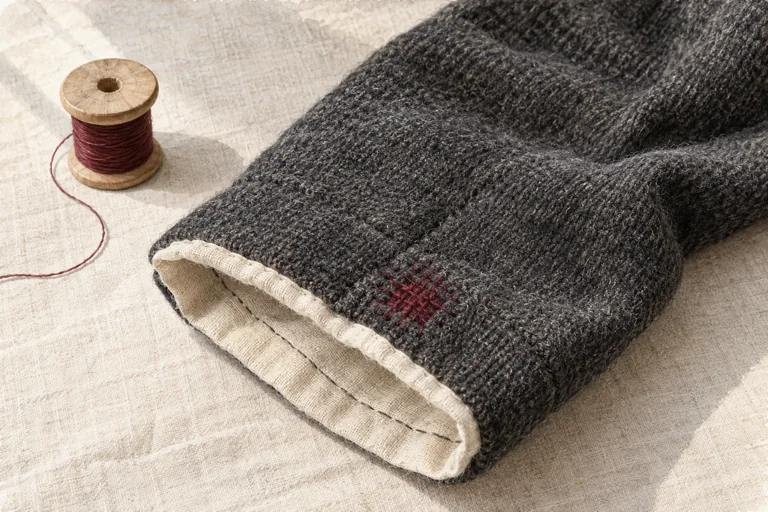
An embroidered surface can catch your eye before you have noticed the cloth beneath it. A bright thread, a small repeated mark or a raised line seems to offer the whole story at once. Look again, however, and decoration becomes a set of decisions: where to place a stitch, how densely to work it and how much of the ground to leave visible. Those questions can enrich a Milan fashion visit without requiring you to become an embroiderer.
The aim is to describe more precisely, not to pronounce an object valuable after a few seconds. A shop window, museum case and close-up photograph each reveal different amounts of information. Begin with what you can actually see, then use the label or maker’s explanation to establish what remains uncertain. That habit is particularly helpful when a seductive surface makes a confident story seem easier than a careful one.
Start with the ground
Our guide to fibre, yarn and fabric supplies a useful first distinction. The base cloth and the threads worked into it are related but separate elements. Ask where the background remains visible and where the embroidery covers it. A pattern might depend as much on a quiet area of unworked fabric as on a dense concentration of stitches.
The V&A’s illustrated guide distinguishes counted-thread approaches from freer arrangements and from forms of whitework. It also cautions that there is no single universal classification across cultures. Use those categories as an introduction rather than a rigid test. A name can help organize attention, but it should not replace the specific terminology used by a museum, maker or community for the object you are studying.
Let repetition and variation do different jobs
A repeated geometric motif invites you to compare intervals and relationships. A flowing floral design may lead your eye in a different way. Neither appearance alone tells you everything about how it was produced. The V&A explains that counted work follows the structure of the ground, while other designs may be transferred or drawn onto fabric. Knowing that distinction gives you a question to ask rather than an instant answer to announce.
Try describing one small passage in ordinary language. Is the line continuous or broken? Does the color change at an edge? Does a raised element cast a shadow? Such observations are useful even when you cannot identify the stitch. Keep your account proportionate to the view: a detail behind glass or on a screen may not reveal the reverse, the support or the sequence in which the work was made.
A sampler can be a record of learning
The V&A’s history of needlework samplers explains their role in recording and referring to designs and effects. That offers a different way to think about a textile that appears to gather unrelated patterns. The object may preserve knowledge, practice or a working reference, rather than a single decorative composition intended for a finished garment.
This does not make every sampler a private diary, or every irregularity proof of an inexperienced maker. Those conclusions require evidence about the particular object. It does suggest a productive question: was this textile made to be worn, displayed, consulted or used to demonstrate skill? The answer can change how you understand its scale and arrangement. An object’s purpose is often more revealing than an unsupported judgment about how long it must have taken.
Keep craftsmanship separate from guesswork
The V&A collection brings together professional and amateur work across different periods and places, including furnishings and dress. Its examples are a research resource in London and online, not a claim that those objects are currently on display in Milan. Use them to develop a vocabulary, then examine the evidence attached to the object actually in front of you.
For a purchase, ask the seller about materials, making and care rather than assuming that a neat pattern proves machine work or an irregular one proves handwork. For a museum visit, our guide to labels and ownership helps separate maker, wearer and donor. In both settings, an honest unanswered question is preferable to a story assembled from the appearance of a few stitches.
Bring the method back to Milan
Our weave and finish article offers a companion way to look at cloth, while the fashion and shopping collection can help you compare city walks. Check whether an experience includes a workshop or demonstration; a fashion-district itinerary does not automatically provide either. It also does not confer an invitation, accreditation or backstage access during Fashion Week.
If textiles become a larger interest, Lake Como’s journal offers a regional starting point for further planning, with each visit and departure town considered separately. For now, choose one embroidered detail to remember accurately. The color may be beautiful, but the deeper pleasure is seeing how that color was organized into a surface—and knowing which parts of its story you have learned, rather than merely guessed.
Sources & further reading
Turn a good read into a great day.
Find a highly rated Milanese experience that brings these stories to life.
Explore related experiences →