Villa Necchi Campiglio: what can interiors add to a Milan fashion visit?

Fashion does not happen against an empty background. A coat is removed in a hall, a guest settles into a chair, and a doorway frames the moment someone enters a room. Villa Necchi Campiglio gives a fashion-minded visitor a different way to explore Milan: through the spaces, materials and rituals surrounding dress. It is an architectural and domestic-history visit, with its own collections and admission arrangements, rather than a shortcut into an official Fashion Week event.
Place the house in its particular Milan
The FAI’s account of the villa dates its construction to 1932–1935 and identifies Piero Portaluppi as its architect. Its clients were the Necchi-Campiglio family, industrialists from Pavia. The building at Via Mozart 14 brings together carefully chosen materials, fitted furnishings and the domestic technologies of an affluent household. Start with that specific setting rather than treating the rooms as an image of how everyone in Milan lived.
Before entering, consider the change of scale from the street to a detached residence and garden. Inside, look at how a visitor would be received and how views connect one space with another. You are observing an arrangement designed for particular people with particular resources. Our Corso Venezia architectural walk provides a nearby urban context, but check the actual route, opening arrangements and time available before combining the two.
Look for material relationships, not a matching outfit
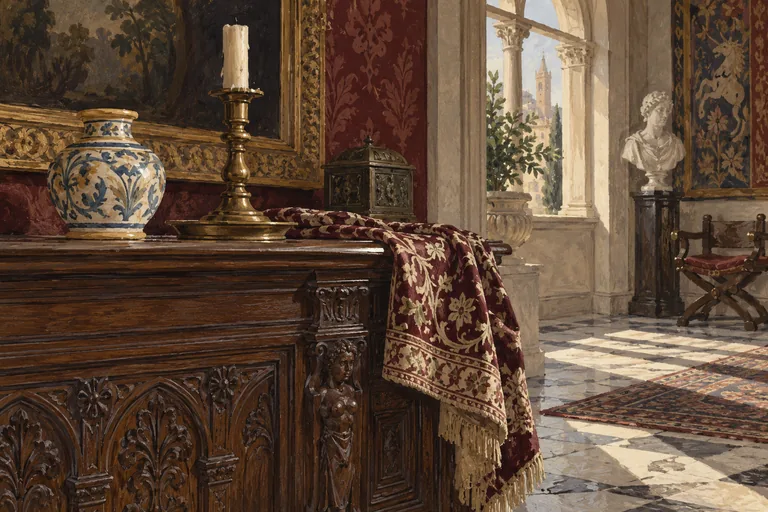
Choose a small grouping: a chair against a wall, a polished surface beside fabric, or the edge of a window meeting a darker furnishing. Ask what makes one material conspicuous and another quiet. A scarf and a room can both use contrasts of sheen, texture and scale, but the comparison is an exercise in looking, not proof that one directly influenced the other.
Stand back before examining a detail. A pattern that is lively close up may settle into a calm surface from across the room. Notice what catches your eye first and whether that changes with your position. If traveling with a companion, each choose a detail without consulting the other, then explain the choice. This is a pleasant way to compare taste without turning the visit into a test of who knows more design terminology.
Separate the original design from later layers
The villa did not stop changing when Portaluppi completed it. FAI identifies Tomaso Buzzi’s intervention in some interiors from 1938, introducing a more historicizing character. That matters when a room seems to contain several design languages. Rather than forcing everything into a single style, ask which element belongs to which phase and consult the interpretation available during your visit.
The Case Museo di Milano account also distinguishes the house from later art donations, including the collections associated with Claudia Gian Ferrari, Alighiero and Emilietta De’ Micheli, and Guido Sforni. A present-day display can illuminate a home without documenting the precise arrangement at one earlier date. Our Bagatti Valsecchi guide develops a related question about collecting, interiors and the periods a household chose to evoke.
Remember the work behind a polished domestic scene
The Milan architects’ order describes the villa’s circulation, including a secondary staircase serving lower-level service areas and rooms for domestic staff above. Use that information to think about different journeys through the same building. The route taken by a guest need not be the route used to prepare a meal or maintain a room.
Stay within the permitted visitor route; the description of a historic space is not an invitation to enter it. Yet even a plan can change what you notice. A refined setting required maintenance, organization and labor. Keeping those aspects in view adds depth to the pleasure of looking at beautiful surfaces and avoids making elegance seem effortless or universal.
Check current access before building the day around it
Use FAI’s current visitor information for tickets, the opening calendar, guided options and access needs. Confirm any particular space or collection you hope to see. Special programmes and ordinary admission may have different arrangements, and an older article about a past exhibition is not a current booking offer. Leave enough room around the visit to enjoy it without watching the clock.
If the trip coincides with Fashion Week, keep confirmed appointments separate from sightseeing ideas. Our guide to planning a comfortable fashion-focused museum day can help you choose a realistic rhythm. A villa admission or shopping tour carries no implied runway invitation.
Carry one observation into the rest of Milan
Compare design and culture experiences for routes that genuinely match your interests and state their inclusions. For a broader city stay, the Milan Tour Hub guide connects cultural visits with other neighborhoods and activities. You might leave Villa Necchi thinking about a texture, a threshold or an unexpected contrast. Let that one observation sharpen the next window display or room you encounter; the city becomes more interesting when you learn to notice relationships.
Sources & further reading
Turn a good read into a great day.
Find a highly rated Milanese experience that brings these stories to life.
Explore related experiences →