Milan’s Museo del Profumo: what can a bottle reveal about style?

A perfume bottle makes a promise before it is opened. Its weight, outline, colour and stopper suggest how the contents should be understood, while a name or a box adds another layer of persuasion. Milan’s Museo del Profumo offers a focused way to examine that relationship. Approach it as a visit to designed objects and their histories, rather than expecting a fragrance counter where every bottle can be tested.
Arrange the appointment first
The museum’s official visitor page says that visits are guided, last about an hour and require advance booking. It currently specifies Italian as the language and a group size from two to twenty-two people. Confirm the actual appointment and any language needs directly before arranging the rest of your day. A request sent to the museum is not yet a confirmed place, and a small private museum should not be treated as a shop with continuous drop-in access.
The address is Via Messina 55, near Cenisio. Check the meeting instructions attached to your booking and allow time to find the correct entrance. If stairs, standing or other access conditions matter to you, ask about the route in advance. These practical questions are especially useful for a compact collection: the visit can feel unhurried when arrival is settled, rather than beginning with uncertainty at the door.
Look at the container before reading the name
Start with the outline of one bottle. Is it upright and architectural, rounded and tactile, or deliberately unexpected? Notice how the stopper relates to the body, where the label sits and how light changes the apparent thickness of the glass. A bottle seen against a pale background may look very different from the same shape in a darker display. Description gives you something precise to discuss before a familiar brand name supplies ready-made associations.
The museum presents glass design for perfumery across the nineteenth and twentieth centuries, including examples connected with major designers and fashion houses. That does not mean every named object on a collection page will necessarily be on view during your appointment. Let the guide establish what you are seeing and which attribution is supported. A manufacturer, bottle designer, fashion label and fragrance creator can represent different roles in the same object’s history.
Separate the bottle’s life from the perfume’s
A surviving container and its original contents do not necessarily preserve the same evidence. Do not assume that an old bottle retains a usable or representative scent, or that it may be opened. The guide can explain what is known about the object without a sensory demonstration. Handling, smelling activities or workshops should be expected only when expressly included in the booked visit. Conservation is not an obstacle to the story; it is part of why the object remains available to study.
This distinction has a useful parallel in reading maker, wearer and donor on fashion museum labels. The person associated with an object is not always its maker or first owner. Ask how a date has been established and whether a display joins items that originally belonged together. A compelling arrangement is not, by itself, evidence of an original pairing.
Ask how luxury is communicated
Rather than deciding immediately whether a bottle is beautiful, ask which choices produce its effect. Does ornament draw attention to craft? Does a plain silhouette make the material more noticeable? Does the packaging resemble an intimate personal object or something intended for display? These questions do not require a hierarchy in which elaborate always means better. Restraint can be as deliberate as theatrical decoration, and both can serve different audiences.
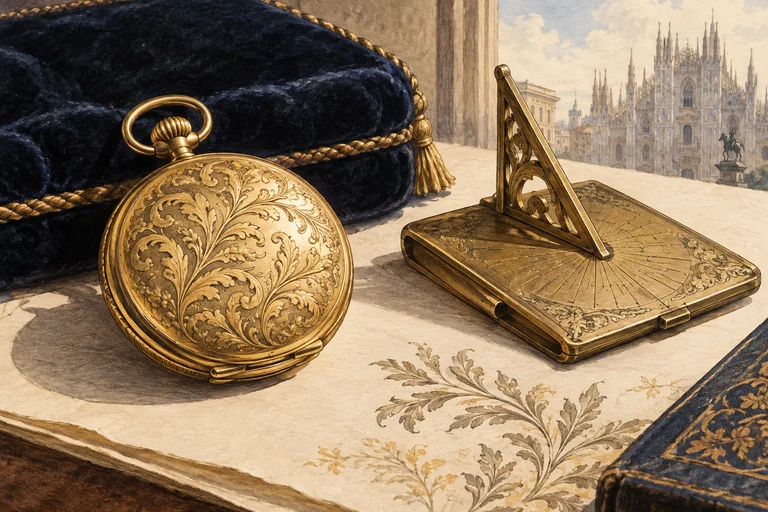
Our guide to small timepieces at Poldi Pezzoli offers another way to consider taste through portable objects. The practical habits in looking closely at a garment also translate: slow down, name what you can see and distinguish construction from marketing language. Museum interpretation should expand your attention, not turn every visit into a shopping recommendation.
Give the visit a considered place in Milan
An hour with a guide can generate more questions than an afternoon of hurried browsing. Leave a quiet interval afterwards to note one shape, one material decision and one uncertainty you would like to investigate. If design is your main interest, Milan’s Triennale guide offers a broader comparison of everyday objects and display. Avoid assuming that the two venues share tickets or booking arrangements.
Browse our design and culture experiences for other ways to structure a Milan stay, reading each itinerary for its actual venues. A cultural visit or shopping tour does not confer Fashion Week invitations, accreditation or runway access. The pleasure here is more specific: discovering how a small glass object can carry a sophisticated argument about identity, desire and the way things are presented.
Sources & further reading
Turn a good read into a great day.
Find a highly rated Milanese experience that brings these stories to life.
Explore related experiences →